Overview
Hadj Mohammed Mesfewi was a Moroccan cobbler and small trader in Marrakesh who, in the early 1900s, became one of the most notorious figures in the country's criminal history. Remembered in later accounts as the "Marrakesh Arch-Killer," he is said to have murdered at least 36 women, luring them to his shop, drugging them, and killing them before concealing their remains beneath his premises and in an adjoining garden.
The case came to light in April 1906, when the disappearances of young women in the city were finally traced back to his shop. It remains one of the earliest widely reported serial-murder cases from Morocco, though much of what is known derives from contemporary newspaper reporting rather than surviving judicial archives, and several details should be treated as traditional accounts rather than fully verified fact. The honorific "Hadj" indicates a person who has completed the pilgrimage to Mecca and is not a given name.
The Murders
According to the documented accounts, Mesfewi targeted young women, some of whom reportedly came to his shop seeking help having letters written. He is said to have drugged his victims before killing them, and the bodies recovered were described as decapitated. His stated motive, as reported in confession, was robbery; the sums he took were often very small, making the scale of the killing all the more disturbing to contemporaries.
He did not act alone. An elderly woman, usually named in accounts as Annah and described as around 70 years old, is reported to have assisted him in luring and overpowering victims. The partnership allowed the killings to continue undetected over an extended period before suspicions in the city finally converged on his shop.
Discovery and Investigation
By April 1906, residents of Marrakesh had become alarmed by the number of young women who had gone missing. Accounts state that the family of one victim traced her last known movements to Mesfewi's shop, prompting authorities to search the premises. Excavations beneath the shop floor and in the adjacent garden uncovered multiple sets of human remains.
The figures most commonly cited describe around 20 bodies in a pit beneath the shop and a further 16 in the garden, totaling at least 36 victims. These numbers come largely from period press coverage and have been repeated in later summaries; they should be understood as the traditionally reported toll rather than an independently confirmed forensic count. Mesfewi was arrested, and his accomplice was also detained. Reports state that she died under interrogation.
Trial and Sentence
Mesfewi was convicted in the wake of the discoveries. Contemporary accounts describe a sentence of execution being handed down in May 1906. According to these reports, the manner of execution shifted amid public outrage and, by some accounts, external diplomatic attention, with crucifixion, beheading, and finally immurement all featuring in the story.
Because the case predates modern documentary record-keeping accessible today, the precise legal proceedings are not fully preserved, and the sequence of sentencing decisions rests on newspaper reporting of the period. What is consistent across accounts is that the punishment ultimately imposed was extraordinarily severe and carried out publicly.
Execution
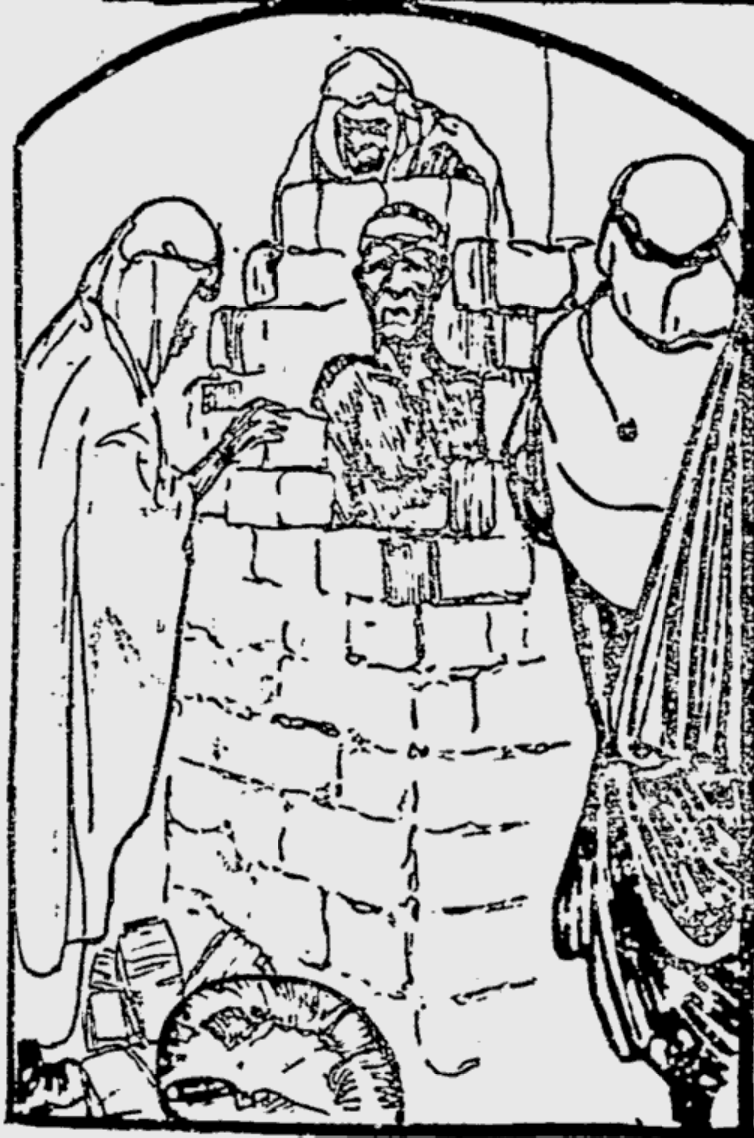
The execution is the most widely retold element of the case. Period accounts state that, before his death, Mesfewi was subjected to public flogging in the market square over a sustained period. The final punishment was immurement: on or around June 11, 1906, he was reportedly walled up alive within the Marrakesh bazaar, sealed into a small recess by masons as crowds looked on.
According to these reports, his cries could be heard for two days before falling silent, and he was presumed dead by June 13, 1906. The grim spectacle drew international press notice at the time and is the principal reason the case endured in later true-crime literature. As with much of the case, the execution narrative comes from contemporary reporting and should be read in that light.
Legacy
Mesfewi's case has been recounted in numerous later true-crime summaries and encyclopedic entries, often emphasizing both the scale of the killings and the severity of the punishment. It is frequently cited as one of the earliest documented serial-murder cases associated with Morocco.
Historians and writers approaching the case today face the challenge that the surviving record is dominated by sensational period journalism. The core outline, a Marrakesh cobbler who murdered women with an elderly accomplice, was discovered in 1906, and was executed by immurement, is consistently reported, but specific figures, names, and procedural details carry varying degrees of certainty and are best presented with appropriate caution.