Background
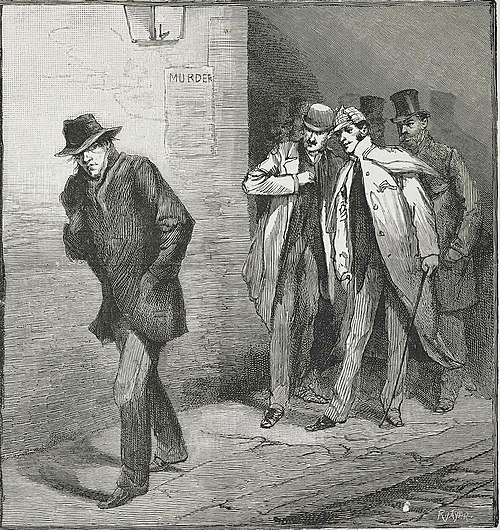
In the autumn of 1888, the impoverished Whitechapel district of London's East End was gripped by a series of brutal murders attributed to an unidentified killer known as Jack the Ripper. The name derives from a taunting letter sent to a news agency, the authenticity of which remains disputed. The killer was never caught, and the case has become one of the most infamous unsolved crimes in history. Five murders are widely regarded by researchers as the work of a single perpetrator and are collectively termed the 'canonical five.'
Mary Jane Kelly, the fifth and final canonical victim, was a young woman believed to have been around 25 years old at the time of her death, though much of her early life is poorly documented and rests largely on her own accounts to acquaintances. She reportedly claimed Irish origins and a period living in Wales before moving to London. By 1888 she was living in poverty in Whitechapel and working as a prostitute, occupying a single rented room at 13 Miller's Court, off Dorset Street.
The Murders
The canonical five Ripper victims are generally listed as Mary Ann Nichols (31 August 1888), Annie Chapman (8 September 1888), Elizabeth Stride and Catherine Eddowes (both killed on 30 September 1888, the so-called 'double event'), and Mary Jane Kelly (9 November 1888). All were women living in poverty in the Whitechapel area, and most had connections to prostitution. The murders were marked by throat-cutting and, in several cases, extensive mutilation of the body.
Kelly's murder, discovered on the morning of 9 November 1888, was the most extensive and brutal of the series. Unlike the earlier victims, who were killed outdoors, Kelly was murdered indoors in the relative privacy of her own room, which allowed the killer considerable time. Her body was found severely mutilated. Witnesses reported having seen her in the hours before her death, and some testimony suggested she had been heard singing late that night, though accounts of the precise timeline are inconsistent.
Investigation
The Whitechapel murders were investigated by the Metropolitan Police, with the City of London Police also involved in the Eddowes case, which fell within their jurisdiction. The investigation was led by senior officers including Inspector Frederick Abberline. Police pursued numerous lines of inquiry, interviewed many witnesses, and examined a large volume of correspondence purporting to come from the killer, most of which is now thought to be hoaxes.
The inquest into Kelly's death was held under coroner Roderick Macdonald. The police surgeon Dr. Thomas Bond examined the body and produced notes that are frequently cited in modern analyses, including an early example of offender profiling. Despite extensive effort, contemporary forensic methods were limited, and no suspect was ever charged. Over the years numerous individuals have been named as suspects by police officials and later authors, but none has been conclusively proven to be the killer. The identity of Jack the Ripper remains unknown.
Outcome
No one was ever arrested, tried, or convicted for the murder of Mary Jane Kelly or any of the canonical Ripper killings. The case remains officially unsolved. The Whitechapel murders file held by the Metropolitan Police covers a broader series of unsolved killings in the area between 1888 and 1891, but the canonical five are the murders most consistently attributed to a single hand.
Because there was no trial, there is no judicial record establishing a perpetrator. Theories about the killer's identity have proliferated for more than a century, ranging from local residents to figures of national prominence, but these remain speculative. The lack of resolution is a defining feature of the case.
Aftermath and Legacy
The Jack the Ripper murders had a lasting impact on Victorian society, drawing intense press attention to the extreme poverty and overcrowding of the East End and contributing to social reform debates of the era. The killings also influenced the development of criminal investigation and are sometimes cited in the early history of psychological profiling.
Mary Jane Kelly's murder, as the final and most savage of the canonical crimes, occupies a particular place in the enduring public fascination with the case. The Ripper story has generated an extensive body of literature, films, walking tours, and amateur and professional investigation, a field sometimes called 'Ripperology.' Researchers continue to debate the victims, the suspects, and even which murders should be attributed to the same killer. Care should be taken to remember that the victims were real, vulnerable women whose lives have often been overshadowed by the mythology surrounding their deaths.