Background
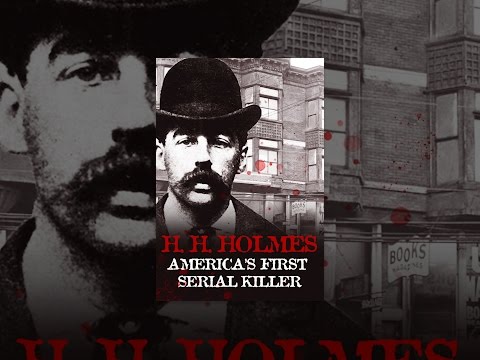
Herman Webster Mudgett, who used the alias Dr. Henry Howard Holmes (commonly H.H. Holmes), was born in Gilmanton, New Hampshire, in 1861. He trained in medicine, graduating from the University of Michigan's Department of Medicine and Surgery in 1884. Even as a young man he was reportedly involved in insurance fraud schemes, including the use of cadavers obtained from the medical school to fake deaths and collect payouts.
Holmes settled in the Chicago area in the late 1880s, taking a position at a drugstore in the Englewood neighborhood. He eventually took over the business. Charismatic, articulate, and persuasive, he cultivated an image of professional respectability that helped him gain the trust of associates, employees, and creditors, while accumulating substantial debts and leaving a trail of unpaid bills and defrauded business partners.
The 'Castle'
Beginning around 1887, Holmes constructed a large mixed-use building on West 63rd Street in Englewood. The three-story structure contained retail space on the ground floor and a warren of rooms on the upper floors. Newspapers later dubbed it the 'Murder Castle.' According to widely circulated accounts, Holmes frequently changed builders so that no single worker understood the full layout, which was said to include windowless rooms, stairways leading nowhere, and concealed passages.
Press reports following his arrest described the building as outfitted for killing and body disposal, with airtight chambers, gas fittings, chutes leading to the basement, and a furnace and quicklime pits. Many of these lurid details originated in sensationalist coverage and cannot be fully verified, particularly because the building was damaged by fire in 1895. The structure was completed around the time of the 1893 World's Columbian Exposition, though claims that it operated as a thriving hotel for fair visitors are largely unsubstantiated.
The Crimes
Holmes's confirmed victims included business associates, employees, lovers, and members of an associate's family. Among the most documented cases were Benjamin Pitezel, a long-time accomplice, and three of Pitezel's children, Alice, Nellie, and Howard, whom Holmes murdered in 1894 and 1895 while moving between several cities to carry out an insurance-fraud scheme.
Holmes profited financially from many of his crimes, collecting life-insurance money and seizing the assets of victims. Several people connected to him, including women he was romantically involved with and former employees, disappeared. After his capture he confessed to 27 murders, but that figure proved unreliable: some named victims were later found alive. Historians continue to debate the true total, with credible estimates ranging from roughly nine confirmable killings to the far higher numbers printed by newspapers of the era.
Investigation and Arrest
Holmes was arrested in Boston in November 1894, initially in connection with the Pitezel insurance fraud rather than murder. Detective Frank Geyer of the Philadelphia police undertook a painstaking investigation into the fate of the missing Pitezel children, tracing Holmes's movements across the United States and Canada. Geyer's work led to the discovery of the children's remains and transformed the fraud case into a murder investigation.
As the case drew national attention, investigators and reporters scrutinized Holmes's Chicago property. The examination of the building, combined with the disappearances of people associated with him, fueled the public narrative of a purpose-built killing house. The story dominated the press, blending verified findings with sensational speculation that would shape Holmes's later reputation.
Trial and Execution
Holmes was tried in Philadelphia in 1895 for the murder of Benjamin Pitezel. He was convicted and sentenced to death. While imprisoned, he produced written confessions, some of which were inconsistent or contradicted by evidence, complicating efforts to determine the full scope of his crimes.
Holmes was hanged at Moyamensing Prison in Philadelphia on May 7, 1896. At his request, his body was reportedly encased in concrete to prevent grave robbing or dissection. In 2017, his remains were exhumed and forensically examined, confirming that the body in the grave was indeed his and laying to rest long-standing rumors that he had somehow escaped execution.
Legacy
H.H. Holmes is frequently described as one of America's first documented serial killers, though that label is contested given earlier cases. His notoriety grew enormously in the late 20th and early 21st centuries, propelled in part by Erik Larson's bestselling 2003 book 'The Devil in the White City,' which interwove Holmes's crimes with the story of the 1893 World's Fair.
Modern historians caution that much of the 'Murder Castle' mythology rests on 1890s yellow journalism and later embellishment rather than verified evidence. The exact number of his victims and many architectural claims about his building remain disputed. Nonetheless, the case endures as a touchstone in American true-crime history and a study in how sensational media can shape public memory of a crime.