Background
Samuel Paty was a 47-year-old history and geography teacher at the College du Bois d'Aulne, a middle school in Conflans-Sainte-Honorine, a town in the Yvelines department northwest of Paris. He was widely described by colleagues and students as a dedicated educator committed to teaching civic values. As part of the French national curriculum on moral and civic education, he taught lessons on freedom of expression, a foundational principle of the French Republic and its secular tradition known as laicite.
In early October 2020, during a class addressing freedom of expression, Paty showed students caricatures of the Prophet Muhammad, including images that had been published by the satirical magazine Charlie Hebdo. Aware that the subject was sensitive for Muslim students, Paty reportedly offered those who might be offended the opportunity to look away or briefly leave the room. The lesson took place against the backdrop of the ongoing trial connected to the January 2015 Charlie Hebdo attack, which had returned the magazine's caricatures to public debate.
Following the class, a dispute arose after accounts of the lesson spread. The father of a student launched an online campaign against Paty, posting videos on social media that named the teacher and his school and called for action against him. A known Islamist activist, Abdelhakim Sefrioui, amplified the campaign. The student's father later acknowledged that his daughter had not actually been present in the class and had given a false account, but the videos had already circulated widely.
The Attack
On 16 October 2020, Samuel Paty was attacked near the College du Bois d'Aulne shortly after the end of the school day. The assailant, 18-year-old Abdoullakh Anzorov, a Russian refugee of Chechen origin, fatally stabbed and beheaded Paty in the street close to the school. Anzorov had reportedly paid students to identify Paty as he left the premises.
After the killing, Anzorov posted images of the attack and a message on social media claiming responsibility and referencing the caricatures. Police arrived quickly at the scene. When confronted, Anzorov was shot and killed by police officers a short distance from the site of the attack. The murder shocked France and was immediately condemned by President Emmanuel Macron, who described it as an Islamist terrorist attack and characterized Paty as a victim killed for embodying the values of the Republic.
Response and Investigation
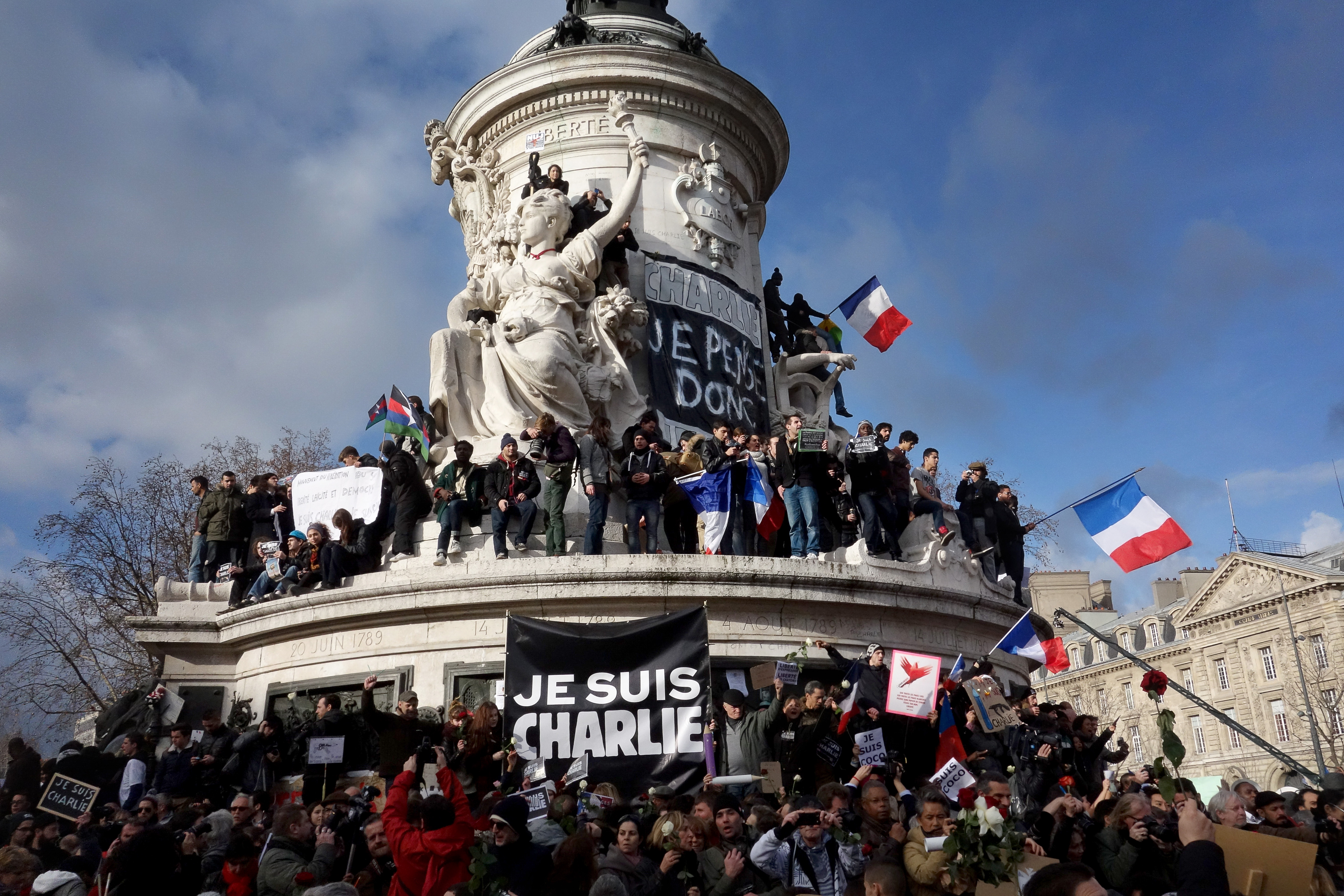
The killing triggered a national outpouring of grief and solidarity. On 18 October 2020, large demonstrations were held in Paris at the Place de la Republique and in cities across France in defense of free expression and in support of teachers. On 21 October 2020, a national homage ceremony was held in the courtyard of the Sorbonne in Paris, where President Macron posthumously awarded Paty the Legion d'Honneur, France's highest order of merit, and delivered a speech defending secularism and freedom of expression.
French authorities opened a counterterrorism investigation. In the days following the attack, police detained numerous individuals connected to the online campaign and to Anzorov's circle. The government also announced measures against radical Islamism, including the dissolution of certain organizations and increased scrutiny of mosques and associations accused of promoting extremism. The case intensified national debate over secularism, online incitement, and the protection of teachers.
The Perpetrator
Abdoullakh Anzorov was born in 2002 and had arrived in France as a young child, with his family obtaining refugee status. At the time of the attack he was 18 years old and held a residence permit. Investigators found that he had become radicalized and had been in contact online with individuals abroad. He had no prior record that flagged him as a serious terrorism risk to the level that would have prevented the attack, though aspects of his online activity later drew scrutiny.
Anzorov did not act on his own knowledge of Paty's identity; investigators established that he was directed to the teacher through the viral online campaign and that he paid pupils outside the school to point Paty out. Because Anzorov was killed at the scene, he could not be tried. The judicial process that followed focused on those accused of aiding, inciting, or providing logistical support connected to the attack.
Trials and Aftermath
Because the killer was dead, French prosecutors pursued cases against alleged accomplices and those linked to the campaign that exposed Paty. In December 2024, a trial opened before a special criminal court in Paris for eight adult defendants accused of involvement, including the father who launched the online campaign and the activist Abdelhakim Sefrioui. In late 2024, the court convicted the defendants on charges ranging from terrorist criminal association to lesser offenses, with sentences varying among the accused; Sefrioui received a lengthy prison term. A separate proceeding addressed the responsibility of several minors who had been schoolchildren, including those accused of helping identify Paty and the pupil whose false account fueled the campaign.
The murder of Samuel Paty became a defining symbol in France of the conflict between freedom of expression and violent extremism, and of the dangers posed by online disinformation and incitement. Schools across France held tributes, and his name has been attached to educational initiatives. The case prompted legislative and policy responses, including a law against online hatred and measures described by the government as combating separatism. Paty is widely remembered as a teacher killed for teaching, and commemorations continue on the anniversary of his death.