Overview
On 7 January 2015, two gunmen forced their way into the Paris editorial offices of the satirical weekly magazine Charlie Hebdo and opened fire, killing 12 people and wounding 11, some of them seriously. The assailants were brothers Saïd and Chérif Kouachi, French citizens of Algerian descent. The attack was widely understood as retaliation for the magazine's repeated publication of caricatures of the Islamic prophet Muhammad, which the magazine had defended as satire and free expression.
The assault was one of the deadliest terrorist attacks in modern French history and triggered three days of related violence in the Paris region. It became a defining moment in European debates over terrorism, freedom of speech, and the limits of satire, and gave rise to the global slogan and hashtag "Je suis Charlie" ("I am Charlie").
The Attack
Shortly after 11:30 a.m., the Kouachi brothers arrived at Charlie Hebdo's offices on Rue Nicolas-Appert in the 11th arrondissement, armed with assault rifles. After initially entering a wrong building, they gained access to the magazine's premises, where an editorial meeting was taking place. They opened fire on staff, killing much of the magazine's senior editorial and cartooning team.
Among those killed were the magazine's editor and cartoonist Stéphane Charbonnier, known as Charb, and several other prominent cartoonists, including Cabu, Georges Wolinski, Tignous, and Honoré. An economist, a copy editor, a maintenance worker, a visitor, and a police protection officer assigned to Charb were also killed. As the gunmen fled, they shot dead a French police officer, Ahmed Merabet, on a nearby street. Witnesses reported that the attackers shouted that they had "avenged the Prophet."
The Manhunt
A large-scale manhunt followed, involving thousands of French security personnel. The brothers were quickly identified, in part because an identification document was reportedly left behind in their abandoned getaway vehicle. Over the following days they moved through the region northeast of Paris, at one point robbing a service station.
On 9 January 2015, the Kouachi brothers took refuge in a printing company in Dammartin-en-Goële, near Charles de Gaulle Airport, where they held a hostage situation. That same day, in a separate but connected attack, Amedy Coulibaly seized hostages at a Hypercacher kosher supermarket at Porte de Vincennes in eastern Paris, killing four people. Coulibaly had earlier been linked to the fatal shooting of a policewoman, Clarissa Jean-Philippe, on 8 January. The crises at both sites were resolved by near-simultaneous police assaults.
Resolution and Perpetrators
On the afternoon of 9 January, French security forces stormed the building in Dammartin-en-Goële. Both Saïd and Chérif Kouachi were killed as they emerged firing at police. Amedy Coulibaly was killed in the assault on the Hypercacher supermarket.
The Kouachi brothers had long been known to French and international intelligence services. Chérif Kouachi had been convicted years earlier for involvement in a network sending fighters to Iraq. The attackers claimed affiliation with al-Qaeda in the Arabian Peninsula (AQAP), and that group publicly claimed responsibility for directing the Charlie Hebdo attack. Coulibaly, by contrast, declared allegiance to the Islamic State group, and the relationship between the two cells became a focus of subsequent investigation.
Aftermath and Legacy
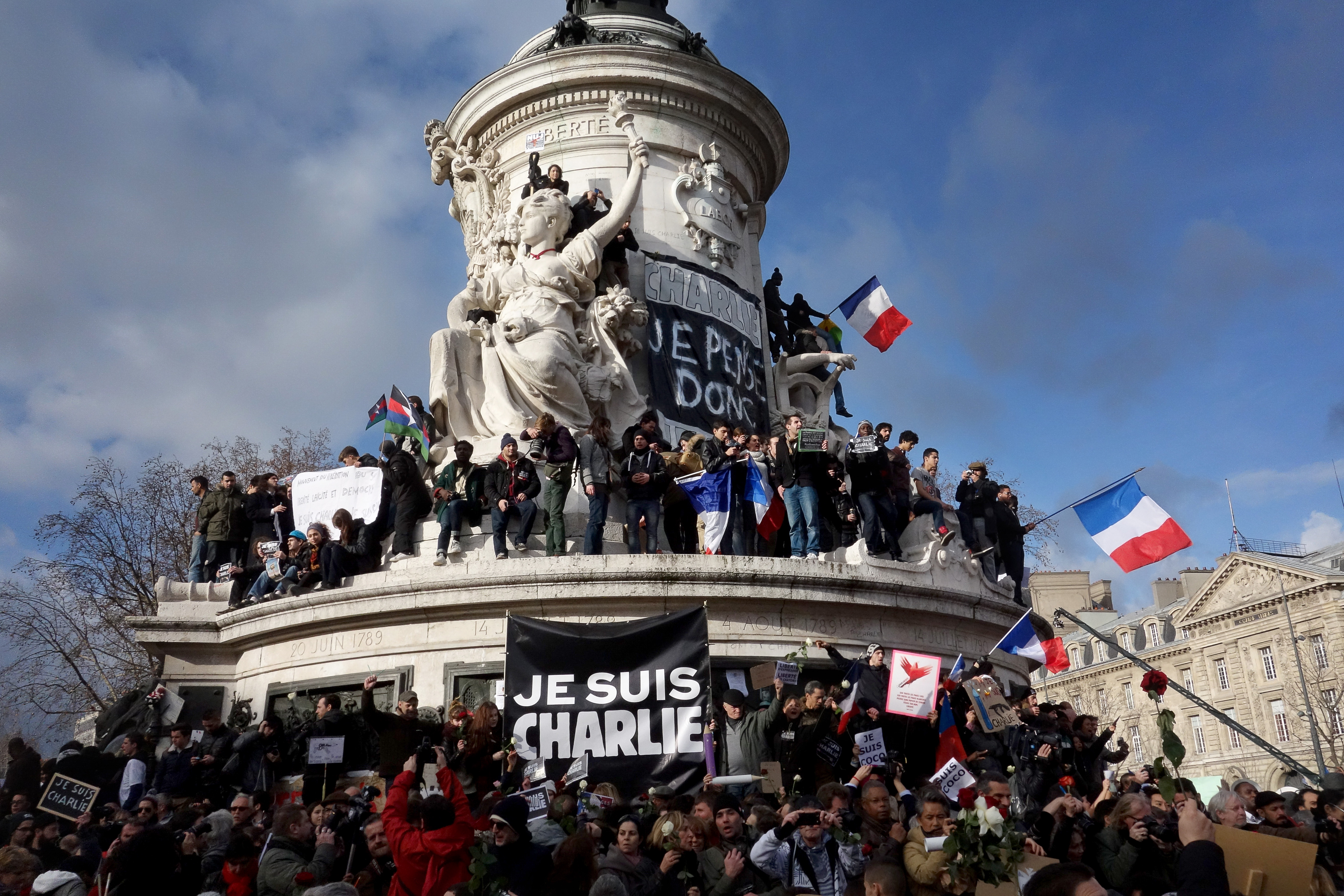
The attacks prompted an extraordinary public response in France. On 11 January 2015, a unity march in Paris drew an estimated 1.5 to 2 million people, joined by numerous world leaders, with millions more participating in rallies across the country. The phrase "Je suis Charlie" spread worldwide as a symbol of solidarity and a defence of free expression, though it also generated debate about the content of the magazine's cartoons.
Charlie Hebdo continued publishing; its first issue after the attack, featuring a cover image of Muhammad, sold millions of copies internationally. In 2020, a French trial of alleged accomplices who helped supply weapons and logistics concluded with convictions. The attack is frequently cited as a watershed in France's experience of jihadist terrorism, preceding the larger November 2015 Paris attacks later that year.