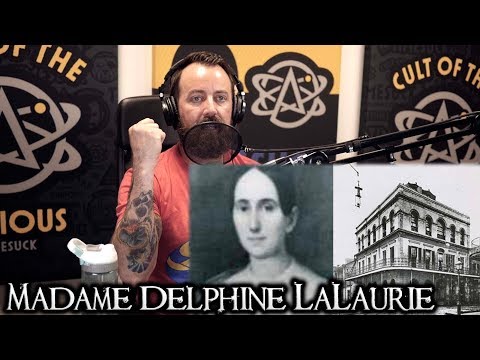
Background and Early Life
Marie Delphine Macarty was born in New Orleans around 1787 into a prominent and wealthy Creole family with deep roots in colonial Louisiana society. The Macartys were socially influential, and several relatives held positions of standing in the city. Delphine grew up amid the privilege of the antebellum South, in a society in which slaveholding was central to wealth and status.
She married three times over the course of her life. Her first husband, Don Ramón de Lopez y Angulo, a Spanish royal officer, died in the early 1800s. Her second marriage, to banker and merchant Jean Blanque, ended with his death. Her third husband, Dr. Leonard Louis Nicolas LaLaurie, a physician considerably younger than she, was the husband to whom she was married at the time of the events that made her infamous. It is by his surname that she is remembered.
The Royal Street Mansion
By the early 1830s, Delphine LaLaurie presided over an elegant mansion at 1140 Royal Street in the French Quarter of New Orleans. She was known as a charming and prominent hostess who entertained the city's elite, and her social standing was considerable. The household included a number of enslaved people who served the family and maintained the residence.
Even before the events of 1834, there were reportedly rumors and concerns about LaLaurie's treatment of the people she enslaved. Accounts describe earlier incidents that drew the attention of neighbors and authorities, including the reported death of a young enslaved girl who fell from the roof. Some sources state that an investigation led to LaLaurie being required to forfeit certain enslaved people, who were then said to have been bought back by relatives and returned to her household. The precise details of these earlier episodes are difficult to verify.
The Fire of 1834
On April 10, 1834, a fire broke out at the LaLaurie mansion. The blaze reportedly originated in the kitchen, and contemporary accounts state that an elderly enslaved cook said she had set it, preferring death to being taken to the upper room where enslaved people were punished. As bystanders, officials, and neighbors responded to the fire, attention turned to the enslaved people inside the burning house.
According to widely circulated newspaper reports of the period, particularly in the New Orleans Bee (L'Abeille), responders discovered enslaved people who had been confined, chained, and subjected to severe mistreatment. The reports described individuals found in conditions of grievous suffering. These accounts shocked the city and circulated rapidly, fueling public outrage against LaLaurie.
Public Outrage and Flight
After the discovery, news of the conditions inside the mansion spread quickly through New Orleans, and a crowd gathered in anger. Reports describe a mob that descended on the Royal Street property and caused significant damage to the house and its contents. The fury of the public reflected the extent to which the reported cruelty exceeded even the brutal norms tolerated within the institution of slavery at the time.
Amid this uproar, Delphine LaLaurie fled the city. Accounts indicate she escaped by carriage, possibly traveling to the coast and then onward. She was never prosecuted or held legally accountable for the alleged atrocities, and the case remained, in effect, unresolved. Her ultimate fate is a subject on which sources differ, with a widely repeated account holding that she eventually settled in Paris and died there in the 1840s.
Disputed Details and Legend
The LaLaurie case sits at the intersection of documented history and embellished legend. Core facts—that a fire occurred at her mansion in April 1834, that enslaved people were found in abusive conditions, that public outrage drove her from the city, and that she was never prosecuted—are supported by contemporary newspaper coverage. However, many of the more lurid details associated with the story today were added or exaggerated in later retellings.
Sensational claims, including descriptions of grotesque medical experiments and elaborate torture, appear largely in much later popular accounts rather than in verifiable contemporary records. Writers in the late nineteenth and twentieth centuries, and later popular media, amplified and dramatized the story. Historians caution that separating the documented record from accumulated folklore is difficult, and that the number of victims and the specific nature of the abuses cannot be established with certainty from reliable sources.
Legacy
The LaLaurie mansion at 1140 Royal Street remains one of the most recognized buildings in the French Quarter and a fixture of New Orleans ghost tours and local lore. Over the years it has changed hands many times and at various points served different functions, while retaining its reputation as a site associated with the 1834 events.
Delphine LaLaurie endures as one of the most notorious figures in American historical memory connected to the cruelties of slavery. Her story has been retold in books, documentaries, and television dramatizations, which have introduced her to wide audiences while also blurring the line between historical fact and embellishment. For historians and the public alike, the case stands as a stark, if partly legend-shrouded, illustration of the violence embedded in the institution of slavery in the antebellum South.