Background: Giovanni Falcone and the War on the Mafia
Giovanni Falcone was an Italian magistrate who became one of the most prominent figures in the fight against the Sicilian Mafia, known as Cosa Nostra. Born in Palermo in 1939, Falcone rose to prominence in the 1980s through his innovative investigative techniques, particularly his strategy of "following the money" through banking records to trace Mafia financial networks. Working closely with fellow magistrate Paolo Borsellino and a group of investigators known as the Antimafia Pool, Falcone built cases that struck at the heart of organized crime in Sicily.
Falcone's most significant achievement was the Maxi Trial (Maxiprocesso) held in Palermo between 1986 and 1987, in which hundreds of Mafia members were prosecuted. The trial relied heavily on the testimony of Tommaso Buscetta, the first major Mafia informant (pentito) Falcone persuaded to cooperate. The Maxi Trial resulted in numerous convictions, and in January 1992 Italy's Supreme Court of Cassation upheld the verdicts, confirming life sentences for top bosses. This confirmation enraged the Cosa Nostra leadership, particularly Salvatore "Totò" Riina, the head of the Corleonesi faction, who sought revenge.
The Attack at Capaci
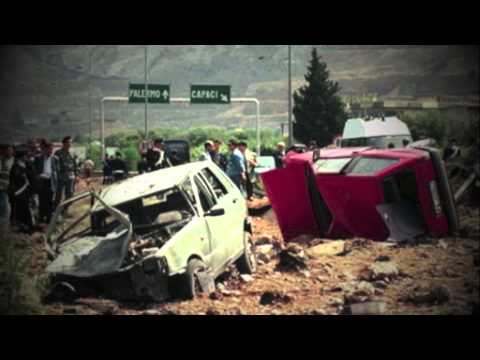
On 23 May 1992, Giovanni Falcone flew from Rome to Palermo's Punta Raisi airport. He was travelling along the A29 motorway toward Palermo in a convoy of three armoured cars. Near the town of Capaci, the Mafia had packed a drainage culvert running beneath the highway with approximately 400 kilograms of explosives. As the convoy passed over the spot, the charge was detonated by remote control from a hillside overlooking the motorway.
The enormous blast tore apart a section of the highway and was so powerful that it registered on local earthquake monitoring instruments. Falcone, who was driving the lead car at the moment of the explosion, was killed along with his wife, Francesca Morvillo, who was also a magistrate. Three police escort officers in the leading vehicle were also killed: Antonio Montinaro, Rocco Dicillo, and Vito Schifani. Several other officers in the convoy were injured. The attack is commonly known in Italy as the Strage di Capaci (the Capaci massacre).
The Perpetrators and the Investigation
The Capaci bombing was ordered by the Cosa Nostra leadership under Salvatore Riina as part of a violent strategy against the Italian state. The man who physically pressed the detonator was Giovanni Brusca, a senior Mafia member and a leader of the San Giuseppe Jato clan. Brusca, sometimes nicknamed "lo scannacristiani" ("the people-slaughterer") and "u verru" ("the pig"), was one of Riina's most trusted and ruthless lieutenants and was responsible for numerous murders.
Less than two months after the Capaci attack, on 19 July 1992, the Mafia struck again, killing Paolo Borsellino and five of his bodyguards with a car bomb in Via D'Amelio in Palermo. The dual assassinations of Falcone and Borsellino caused widespread national outrage and galvanized public opinion against the Mafia. The Italian state responded with intensified pressure, the deployment of military units to Sicily, and tougher anti-Mafia measures, including the use of the strict 41-bis prison regime. Salvatore Riina was captured in January 1993.
The Arrest of Giovanni Brusca
Giovanni Brusca remained a fugitive for several years after the bombing. He was arrested on 20 May 1996 in a villa near Agrigento in Sicily. Following his capture, Brusca eventually chose to collaborate with prosecutors and became a state witness (pentito), providing detailed testimony about Cosa Nostra's internal structure, its murders, and its strategy of confronting the state.
Brusca's confessions were extensive and disturbing. He admitted personal involvement in a large number of murders, with estimates of the killings he ordered or carried out ranging widely into the dozens or more. Among the most notorious crimes he confessed to was the kidnapping, prolonged captivity, and murder of Giuseppe Di Matteo, the young son of another informant, whose body was dissolved in acid in an attempt to silence the boy's father. Brusca's role in this killing became emblematic of the Mafia's brutality.
Trials and Outcome
Brusca was convicted for his role in the Capaci bombing and numerous other crimes. As a collaborating witness whose testimony proved valuable to investigators, he received reduced sentencing benefits under Italian laws that reward cooperation with justice. This arrangement was deeply controversial given the scale of his crimes, and it provoked strong reactions, particularly from the families of his victims.
In May 2021, after serving 25 years in prison, Giovanni Brusca was released. His release sparked significant public debate and outrage in Italy, with relatives of Mafia victims expressing anger that a man responsible for so many deaths, including the Capaci massacre, would be freed. Under the terms applicable to former collaborators, he remained subject to monitoring and restrictions following his release. Other Mafia figures involved in the planning and execution of the Capaci attack received life sentences, including Salvatore Riina, who died in prison in 2017.
Legacy
The Capaci bombing, together with the murder of Paolo Borsellino, marked a turning point in Italy's struggle against organized crime. Rather than intimidating the state into retreat, the attacks intensified the national commitment to fighting the Mafia and produced a wave of public solidarity with anti-Mafia magistrates. Palermo's airport was renamed Falcone-Borsellino Airport in honour of the two judges.
Giovanni Falcone and Francesca Morvillo, along with the police escorts who died protecting them, are commemorated as symbols of sacrifice and integrity in Italian public life. Each year on 23 May, commemorations are held in Palermo and across Italy to honour the victims of Capaci. The tree outside Falcone's former home, known as the Falcone Tree (Albero Falcone), has become a place of pilgrimage and remembrance. The events of 1992 remain a defining chapter in modern Italian history and in the broader fight against Cosa Nostra.