Overview
On the morning of 11 March 2004, a series of coordinated bomb explosions struck four commuter (Cercanías) trains in and around Madrid, Spain, during the busy morning rush hour. The attacks killed 193 people and injured roughly 2,000 others, making them the deadliest terrorist attack in Spanish history and one of the worst in modern European history. The bombings occurred just three days before Spain's general election, scheduled for 14 March 2004, and had a significant impact on the political climate of the country.
The attacks are commonly referred to in Spain as 11-M, echoing the shorthand used for the 11 September 2001 attacks in the United States. They were carried out by a terrorist cell inspired by al-Qaeda, using improvised explosive devices placed in backpacks and sports bags aboard the trains.
The Attacks
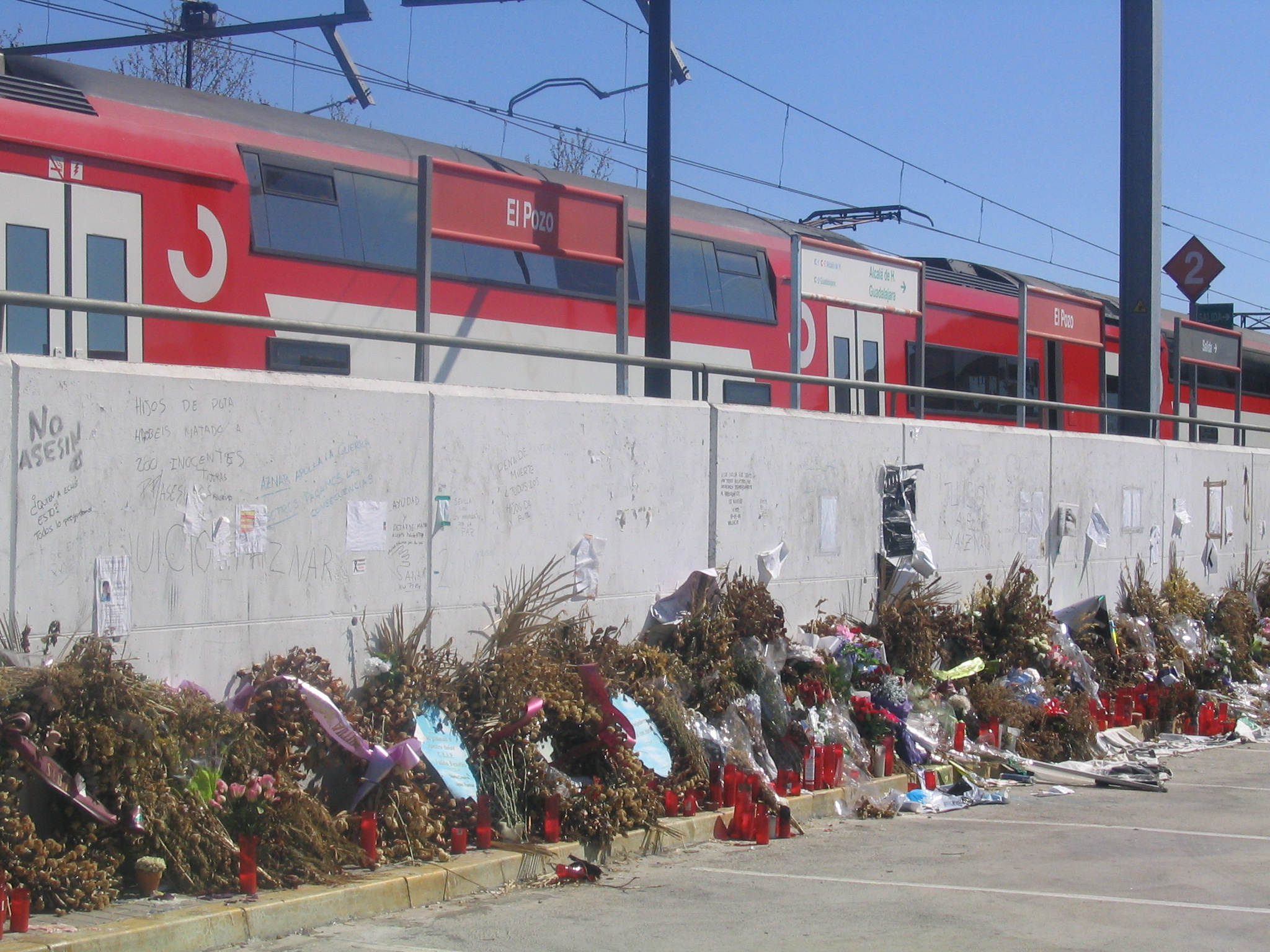
A total of ten bombs detonated within a short window during the early morning of 11 March 2004, between roughly 7:37 and 7:40 a.m. local time. The explosions affected trains at or near several points on the Cercanías network serving the southeastern corridor into central Madrid, including Atocha station, the El Pozo del Tío Raimundo and Santa Eugenia stations, and a train on the Calle Téllez near Atocha. The bombs had been concealed in bags left aboard packed commuter trains carrying workers and commuters into the city.
Several additional explosive devices did not detonate. Investigators recovered unexploded bombs, and the explosives and a mobile phone associated with one device provided crucial forensic and investigative leads that helped identify those responsible. The scale of casualties was magnified by the crowded conditions of the trains during rush hour.
Investigation and Perpetrators
In the immediate aftermath, the Spanish government initially suggested that the Basque separatist group ETA might be responsible, a claim that became politically contentious in the days that followed. As the investigation progressed, evidence pointed instead toward a cell of Islamist extremists inspired by al-Qaeda's ideology rather than a directly commanded operation. Investigators traced the explosives and tracked suspects through forensic evidence, including a recovered mobile phone.
On 3 April 2004, as police closed in on a group of suspects in an apartment in the Madrid suburb of Leganés, several of the cornered men detonated explosives, killing themselves and a member of the Spanish special police forces. The dispute over attribution between ETA and Islamist perpetrators, and the government's handling of public information in the days before the election, remained a subject of intense political debate in Spain.
Political Aftermath
The bombings occurred three days before Spain's general election. The governing Partido Popular, led by Prime Minister José María Aznar, had supported the United States-led invasion of Iraq, a deployment opposed by a large share of the Spanish public. The handling of information about responsibility for the attacks, amid suspicion that the government favored attributing them to ETA, fueled controversy in the final days of the campaign.
In the 14 March 2004 election, the opposition Spanish Socialist Workers' Party (PSOE), led by José Luis Rodríguez Zapatero, won. The new government subsequently moved to withdraw Spanish troops from Iraq. The degree to which the attacks influenced the election outcome has been widely discussed and debated by analysts and remains a matter of differing interpretations.
Trial and Legal Outcome
A major trial of those accused in connection with the bombings was held in Madrid in 2007. In October 2007, the court delivered its verdicts, convicting a number of defendants on charges related to the attacks while acquitting others. Some defendants received very long prison sentences for their roles, while the court did not uphold every charge sought by prosecutors, and certain high-profile defendants were cleared of the most serious counts.
Because several of the principal suspects had died in the Leganés explosion in April 2004, they could not be brought to trial. The verdicts were subsequently subject to appeals and partial revisions by Spain's higher courts. The precise convictions, sentences, and later modifications are detailed in court records and remain the authoritative account of legal responsibility.
Memory and Legacy
The 11-M bombings left a lasting mark on Spanish society. Memorials have been dedicated to the victims, including a monument at Atocha station, one of the principal sites affected by the attacks. Anniversary commemorations are held in Madrid each year to honor those who died and the many who were injured.
The attacks reshaped debates in Spain and across Europe about terrorism, intelligence, and security on public transport, and they are frequently cited alongside other major terrorist incidents of the early 2000s. For many in Spain, 11-M remains a defining national tragedy and a reference point in discussions of political accountability and counterterrorism policy.