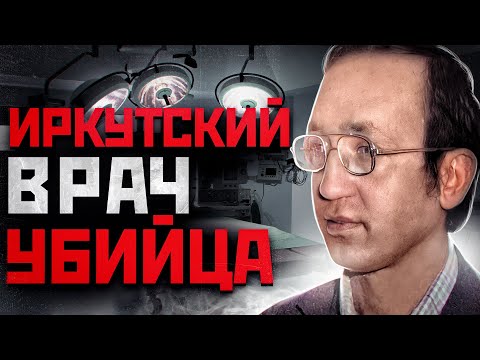
Vasili Kulik was a respected emergency physician and pediatrician in Irkutsk, Siberia, married with a family and active in his local community. Operating between 1984 and 1986, he used his medical position and trustworthy demeanor to gain access to victims at the extremes of age, including elderly women and young children. He confessed to a series of rapes and murders and was convicted and sentenced to death.
Known Victims
At least 13 total — known victims include:
Unnamed elderly and child victims
Location
Irkutsk, Russia
Summary
Vasili Kulik, a trusted physician in Irkutsk, Siberia, murdered and assaulted numerous victims, primarily elderly women and children, before his arrest in 1986.
Details
Vasili Kulik was a doctor in the Siberian city of Irkutsk who committed a series of rapes and murders between roughly 1984 and 1986. His victims spanned a wide age range, including elderly women and young children, and he exploited the trust afforded by his profession to approach and attack them. He was reported to have confessed to numerous offences after his arrest. Kulik was convicted and sentenced to death, and the sentence was carried out by execution. The case is frequently cited among notable Soviet-era serial murder investigations.
Overview
Vasiliy Sergeyevich Kulik (born 17 January 1956 in Irkutsk, RSFSR, Soviet Union) was a Soviet serial killer, rapist and child molester active in the Siberian city of Irkutsk in the mid-1980s. A trained physician who worked as an ambulance medic, Kulik used the trust associated with his profession to approach and overpower vulnerable victims. He was convicted of 13 murders and a large number of sexual assaults committed over roughly a two-year period, and he became one of the most notorious criminal cases in late-Soviet Russia.
Kulik's victims were drawn from two groups he specifically targeted: young children and elderly women. The case drew lasting attention both because of the brutality of the crimes and because the perpetrator was an educated, professionally respected medical worker, a contrast that figured heavily in later Russian press coverage and television dramatizations.
Background
Kulik was born into an educated family in Irkutsk. According to Russian and English-language accounts, his father was a scientist and writer and his mother worked in education. He served in the Soviet Army in the mid-1970s before studying medicine at the Irkutsk Medical Institute, graduating in 1982. He subsequently worked as a medic at an emergency/ambulance station in Irkutsk.
Outwardly, Kulik presented as a stable, respectable professional, which contributed to his ability to avoid suspicion for an extended period. This combination of an ordinary public life and concealed violent offending became a defining feature of how the case was later reported.
Crimes
Kulik's killings are generally dated to the period from 1984 to 1986. Sources indicate his first murder involved an elderly woman whom he drugged, assaulted and strangled. Over the following two years his victims included both children and elderly women. Reported figures describe a total of 13 murder victims, commonly broken down as six children and seven elderly women, alongside a much larger number of rapes and assaults often cited as close to 30.
The ages of his victims spanned a wide range, with reports citing victims as young as around two years old and as old as their seventies. His offending pattern, targeting the very young and the very old, two of the most defenseless groups, was central to public revulsion at the case. Some Russian press accounts associate his attacks with particular timing, though such details are part of sensationalized coverage and should be treated with caution.
Arrest
Kulik was apprehended on 17 January 1986, which was his 30th birthday. According to widely repeated accounts, he was caught during or attempting another attack when ordinary citizens intervened: bystanders who had heard about the killer operating in Irkutsk noticed something wrong, raised the alarm, and helped subdue and detain him before turning him over to the police.
His capture relied heavily on alert members of the public rather than on his prior identification as a suspect, underscoring how effectively his respectable profession had shielded him from earlier scrutiny.
Trial, Sentence and Execution
Following his arrest, Kulik confessed to the murders. Some accounts note that elements of his initial testimony were doubted until further investigation corroborated them. He was convicted on 11 August 1988 of the 13 murders together with the additional rapes and assaults attributed to him.
Kulik was sentenced to death. He was executed by firing squad on 26 June 1989 in Irkutsk. Capital punishment was still in use in the Soviet Union at the time, and his execution closed one of the era's most infamous Siberian criminal cases.
Legacy
The Kulik case remained well known in Russia and has been revisited in numerous press features and true-crime retrospectives, frequently framed around the disturbing image of a doctor, a figure of trust and healing, as a predator. It is sometimes referenced in popular Russian culture and television treatments of real Soviet-era killers.
Because much of the detailed reporting comes from later journalistic and true-crime sources rather than contemporaneous official records available in English, some specific figures, particularly the exact number of rapes and certain biographical particulars, vary between accounts and should be regarded as approximate.
Video Coverage
Frequently asked questions
What was the The Irkutsk Doctor Killings case?
Vasili Kulik, a trusted physician in Irkutsk, Siberia, murdered and assaulted numerous victims, primarily elderly women and children, before his arrest in 1986.
Who was responsible for The Irkutsk Doctor Killings?
Vasili Ivanovich Kulik. Vasili Kulik was a respected emergency physician and pediatrician in Irkutsk, Siberia, married with a family and active in his local community. Operating between 1984 and 1986, he used his medical position and trustworthy demeanor to gain access to victims at the extremes of age, including elderly women and young children. He confessed to a series of rapes and murders and was convicted and sentenced to death.
How many victims were there in the The Irkutsk Doctor Killings case?
At least 13 victims are associated with this case, including named victims such as Unnamed elderly and child victims.
Where and when did the The Irkutsk Doctor Killings case take place?