Background and Early Life
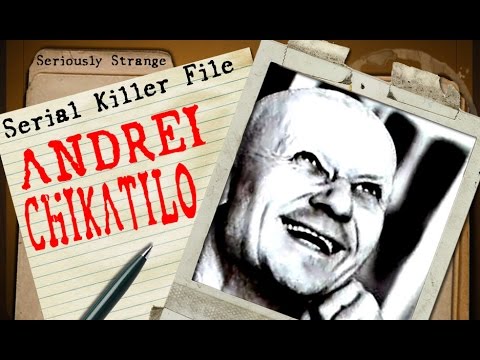
Andrei Romanovich Chikatilo was born on October 16, 1936, in Yablochnoye, a village in the Ukrainian Soviet Socialist Republic. He grew up amid the severe deprivation of the Soviet 1930s, including the famine of that era, and later spoke of a family account that an older brother had been kidnapped and cannibalized during the famine, though this claim has never been independently verified. Chikatilo was a reportedly bright but withdrawn child who suffered from bullying, chronic shyness, and lifelong difficulties with sexual function that he described as a source of deep humiliation.
As an adult, Chikatilo completed military service, married, and had two children. He earned a degree in Russian literature and worked for years as a schoolteacher before being forced to leave the profession following complaints of inappropriate conduct toward students. He subsequently took a job as a traveling supply clerk (a 'snabzhenets') for industrial enterprises, a role that required frequent rail and bus travel across the Rostov region and beyond. This mobility would later allow him to seek out victims across a wide geographic area and complicate the eventual investigation.
The Murders
Chikatilo's first known killing occurred in December 1978 in Shakhty, an industrial town in Rostov Oblast, when he murdered nine-year-old Yelena Zakotnova. He was questioned at the time but escaped suspicion, in part because another man, Aleksandr Kravchenko, was wrongly convicted and later executed for the crime. Chikatilo did not kill again, as far as is known, until 1982, after which his offending escalated sharply through the 1980s and into the early 1990s.
Over roughly twelve years, Chikatilo lured women, teenage girls, and young boys away from train stations, bus stops, and markets, often approaching runaways, vagrants, or those who appeared vulnerable. He typically led victims into nearby woods or remote areas under various pretenses before attacking them. His killings were marked by extreme violence and mutilation. Chikatilo was ultimately convicted of 52 murders, though investigators and Chikatilo himself referenced differing totals at various points, and the precise number remains a subject of some discussion.
The Investigation
The case became one of the largest manhunts in Soviet history. The investigation, at times led by detective Viktor Burakov, was hampered by several factors: the Soviet authorities' initial reluctance to publicly acknowledge that a serial killer was operating, the killer's wide travel radius, and forensic limitations of the era. Early blood-typing analysis pointed investigators away from Chikatilo because his blood group did not appear to match semen samples recovered from crime scenes, an apparent discrepancy sometimes attributed to a rare non-secretor or 'paradoxical secretor' condition, a point that has been debated.
Chikatilo was first detained in 1984 in connection with the killings and on unrelated theft matters but was released for lack of conclusive evidence. Authorities eventually deployed extensive surveillance around transit hubs. In November 1990, Chikatilo was observed near a railway station shortly after another murder and emerging from a wooded area; he was placed under watch and arrested days later, on November 20, 1990.
Arrest, Confession and Trial
Following his arrest, Chikatilo was interrogated over a period of days. A psychiatrist, Aleksandr Bukhanovsky, who had earlier helped develop an offender profile, was brought in and read portions of that profile to Chikatilo, after which Chikatilo began to confess. He admitted to a large number of killings, including some not previously connected to the case, and led investigators to remains in several locations.
Chikatilo's trial opened in Rostov-on-Don in April 1992. He was held in a metal cage in the courtroom, partly for his own protection from the grief-stricken and enraged families of victims who packed the proceedings. His courtroom behavior was erratic, and questions about his sanity were raised, but he was found legally responsible for his actions. In October 1992 he was convicted of 52 of the 53 murders with which he had been charged and sentenced to death.
Execution and Legacy
After his appeals were rejected, Andrei Chikatilo was executed by a single gunshot to the back of the head on February 14, 1994, at a prison in Novocherkassk. His case had a lasting impact on Soviet and Russian society, forcing greater official acknowledgment that serial homicide could and did occur within the USSR, contrary to earlier ideological claims that such crimes were a product of capitalist societies.
The wrongful execution of Aleksandr Kravchenko for Chikatilo's first murder remains a notable and troubling element of the case, frequently cited in discussions of capital punishment and investigative error. Chikatilo's crimes have been the subject of extensive books, documentaries, and dramatizations, including Robert Cullen's 'The Killer Department' and the 1995 film 'Citizen X.' He is commonly referred to by nicknames such as the 'Butcher of Rostov,' the 'Rostov Ripper,' and the 'Red Ripper,' and his case is widely studied in criminology and forensic psychology.