Overview
Laci Peterson, a 27-year-old substitute teacher who was eight months pregnant, was reported missing from her Modesto, California home on December 24, 2002. Her husband, Scott Lee Peterson, said he had left that morning for a solo fishing trip to the Berkeley Marina on San Francisco Bay, roughly 90 miles away, and returned to find her gone. The couple had planned to name their unborn son Conner. The disappearance drew intense national media attention, in part because of Laci's advanced pregnancy and the approaching Christmas holiday.
Nearly four months later, in mid-April 2003, the badly decomposed remains of a near-term male fetus and, a day later, a partial female torso washed ashore along the Richmond shoreline of San Francisco Bay, only miles from where Scott Peterson said he had been fishing. DNA testing identified the remains as Laci and Conner Peterson. Scott Peterson was arrested on April 18, 2003, near La Jolla, California, and charged with two counts of murder.
Laci's disappearance and the search
When Laci was reported missing on Christmas Eve, volunteers and law enforcement launched a large search across Modesto and surrounding areas. The case quickly became a fixture of cable news coverage. Scott Peterson initially participated in public appeals and search efforts, and Laci's family stood beside him in the early weeks before relations deteriorated.
Investigators grew suspicious of Scott's account. His stated alibi of fishing alone on the bay on a cold December morning, combined with the later discovery of the remains near that location, focused attention on him. Police monitored his activities and communications as the investigation progressed, and the absence of evidence supporting alternative theories of an abduction added to the scrutiny.
Investigation and key evidence
A pivotal development was the revelation that Scott Peterson had been having an affair with a Fresno massage therapist named Amber Frey. Frey came forward to police and later cooperated by recording phone conversations with Peterson. In some calls made after Laci vanished, Peterson misled Frey about his circumstances. Prosecutors argued the affair and Peterson's desire to escape impending fatherhood and marriage supplied a motive.
The prosecution's case was largely circumstantial. Key elements included the location of the recovered remains relative to Peterson's claimed fishing spot, his purchase of a boat he had not told family about, cement residue and homemade anchor materials, and his behavior after the disappearance, including changing his appearance and being found with large amounts of cash, his brother's identification, and camping gear near the Mexican border at the time of his arrest. The defense contended the evidence was inconclusive and that someone else could have abducted Laci.
Trial and conviction
Because of extensive pretrial publicity in Modesto, the trial was moved to Redwood City in San Mateo County. Proceedings began in 2004 and were closely followed nationally. Prosecutors did not establish a precise cause of death or a definitive crime scene, relying instead on the accumulation of circumstantial evidence and Peterson's conduct.
On November 12, 2004, a jury found Scott Peterson guilty of first-degree murder for the death of Laci and second-degree murder for the death of Conner. In the penalty phase, the jury recommended death, and in March 2005 the judge formally sentenced Peterson to death. He was sent to San Quentin State Prison's death row. Peterson has consistently maintained his innocence.
Appeals and post-conviction developments
In August 2020, the California Supreme Court overturned Scott Peterson's death sentence, ruling that the trial court had made errors during jury selection by improperly dismissing potential jurors who expressed general opposition to the death penalty without adequately determining whether they could still follow the law. The court left his underlying murder convictions intact.
Separately, the California Supreme Court directed a lower court to examine a claim of possible juror misconduct involving a juror who had not disclosed prior involvement in legal proceedings. In late 2021, a San Mateo County judge ordered Peterson resentenced; he was resentenced to life in prison without the possibility of parole. The juror-misconduct claim was later rejected, and his conviction was upheld. In subsequent years, Peterson's legal team, working with the Los Angeles Innocence Project, sought new DNA testing of certain pieces of evidence, and related post-conviction litigation has continued.
Legacy
The case had a lasting cultural and legal impact in the United States. The deaths of Laci and Conner contributed to the passage in 2004 of the federal Unborn Victims of Violence Act, sometimes referred to as Laci and Conner's Law, which allows a separate charge for harm to a fetus during the commission of certain federal crimes against a pregnant person.
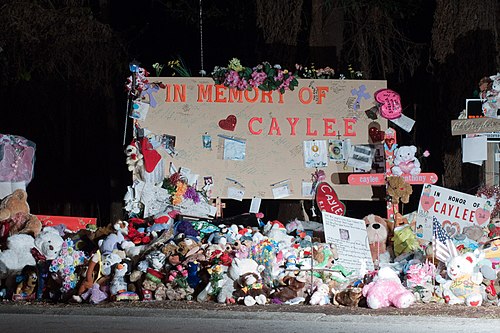
The investigation and trial became a defining example of saturation true-crime media coverage in the early 2000s and have been revisited in numerous documentaries and television specials. The case continues to attract public attention, particularly as later DNA-testing requests and post-conviction proceedings keep it in the news. Laci and Conner Peterson are remembered by family and community members, and memorial events have marked the anniversaries of their deaths.