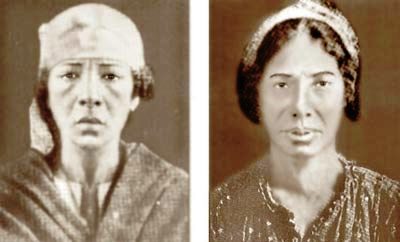
Background
Raya and Sakina Ali Hammam were Egyptian sisters whose names became synonymous with one of the most notorious criminal cases in modern Egyptian history. Born in Upper Egypt in the town of al-Manshiyya near Sohag, they moved with their families to Alexandria, a cosmopolitan Mediterranean port city that, in the early twentieth century, was experiencing rapid growth and social change under British occupation. The sisters settled in the poor and densely populated district of al-Labban, an area known for prostitution, hashish dens, and a transient population that allowed criminal enterprises to flourish with relative anonymity.
The two women operated establishments that functioned as brothels and gathering places. Working alongside their husbands and a small circle of accomplices, they cultivated relationships within the local underworld. The lawlessness of the neighborhood, combined with the social vulnerability of women who frequented such places, created the conditions in which their crimes would go undetected for a significant period. Their case unfolded against a backdrop of the 1919 Egyptian revolution and the political turmoil of the era.
The Murders
Between roughly 1919 and 1920, Raya, Sakina, their husbands Hasaballah and Mohamed Abdel Aal, and several accomplices carried out a series of murders targeting women. The motive was robbery: the victims were typically lured to the sisters' premises, frequently after being identified as wearing gold jewelry. Once inside, the victims were given drink, then attacked and strangled or suffocated, after which their gold and valuables were stripped from their bodies.
The bodies were buried beneath the floors of the houses controlled by the gang. This method of disposal initially helped conceal the scale of the killings, as the victims, often women of modest means or marginal social standing, were not always promptly reported missing. The number of victims is most commonly cited as seventeen women, though some accounts give slightly different figures. The crimes were notable for being among the earliest documented cases of serial murder to receive widespread public attention in Egypt.
Investigation and Discovery
The case unraveled in 1920 when investigators, prompted by reports of missing women and a foul odor associated with the houses, began to focus on the properties linked to the gang. Excavations beneath the floors of the dwellings uncovered the buried remains of numerous victims, confirming the suspicions of police and producing physical evidence that connected the killings to Raya, Sakina, and their associates.
The discovery of multiple bodies caused a sensation in Alexandria and across Egypt. The investigation implicated the two sisters together with their husbands and additional members of the group. The revelation that women were central figures in a robbery-murder enterprise of this scale shocked Egyptian society and dominated newspaper coverage of the period, cementing the case in public memory.
Trial and Execution
Raya, Sakina, and their co-defendants were brought to trial for the murders. The proceedings drew intense public interest. The principal defendants, including the two sisters and their husbands, were convicted and sentenced to death. The executions were carried out by hanging in 1921.
Raya and Sakina are widely described as the first women to be executed by the modern Egyptian state. This distinction, combined with the nature of their crimes, gave the case an enduring notoriety. The executions marked a symbolic moment in the history of Egyptian criminal justice and were widely reported at the time.
Legacy in Egyptian Culture
The story of Raya and Sakina has had an exceptionally long afterlife in Egyptian popular culture, where their names became a byword for evil and treachery, frequently invoked in everyday speech. The case inspired numerous works across film, theater, and television over the following decades.
Among the best-known adaptations is the 1953 Egyptian film about the sisters, and later stage and television productions, including a popular television drama that revisited the story for new audiences. These works have helped keep the case in the public consciousness, though many dramatizations take artistic liberties with the historical record. The persistence of the Raya and Sakina story reflects both its genuine historical significance and its function as a cautionary tale in Egyptian collective memory.