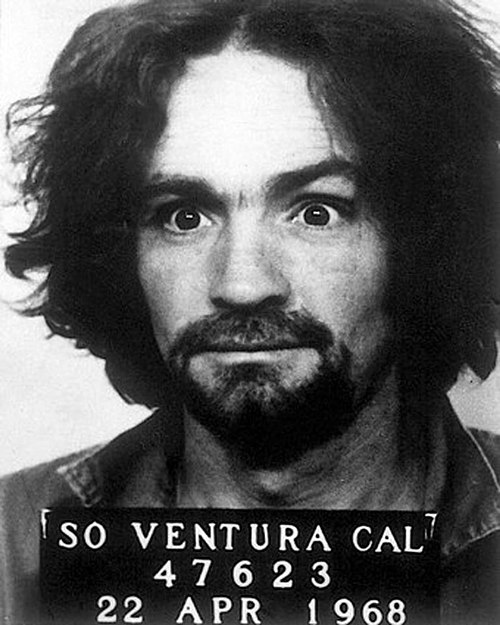
Background: Charles Manson and 'The Family'
Charles Milles Manson was born on November 12, 1934, in Cincinnati, Ohio. He spent much of his early life in and out of correctional institutions, having been convicted of a range of offenses including theft and pimping. By the time of his release from prison in March 1967, he had spent more than half his life in custody.
After his release, Manson gravitated to the San Francisco Bay Area during the 'Summer of Love' counterculture period. He attracted a group of mostly young followers, predominantly women, who became known as the 'Manson Family.' The group eventually settled at Spahn Ranch, a former movie set near Los Angeles. Manson exerted significant psychological control over his followers, blending elements of pseudo-philosophy, scripture, drug use, and apocalyptic prophecy.
Manson developed a belief he called 'Helter Skelter,' a phrase borrowed from a Beatles song. He claimed an imminent, apocalyptic race war was coming and that the murders his followers committed would help ignite it, after which he and the Family would emerge to lead.
The Murders
On the night of August 8-9, 1969, Manson directed several followers to the home at 10050 Cielo Drive in Los Angeles, formerly rented by music producer Terry Melcher. Manson Family members Charles 'Tex' Watson, Susan Atkins, Patricia Krenwinkel, and Linda Kasabian travelled to the property. Five people were killed: actress Sharon Tate, who was eight and a half months pregnant; celebrity hairstylist Jay Sebring; coffee heiress Abigail Folger; writer Wojciech Frykowski; and Steven Parent, a young man who had been visiting the property's caretaker.
The following night, August 10, 1969, Manson personally accompanied a larger group to the Los Feliz home of supermarket executive Leno LaBianca and his wife Rosemary LaBianca. Manson reportedly tied up the couple before leaving. Watson, Krenwinkel, and Leslie Van Houten then killed Leno and Rosemary LaBianca. The killers wrote words including 'Death to Pigs,' 'Rise,' and a misspelled 'Healter Skelter' at the crime scenes using the victims' blood, in part to mislead investigators.
Investigation and Arrests
Initially, investigators did not connect the Tate and LaBianca murders, and leads were slow to develop. The breakthrough came largely through unrelated investigations. Members of the Manson Family were arrested in the autumn of 1969 on other charges, including auto theft, at locations such as Spahn Ranch and the Barker Ranch in Death Valley.
Susan Atkins, while in custody, spoke about the killings to fellow inmates, and her statements helped link the Family to the murders. Los Angeles prosecutor Vincent Bugliosi led the case. Linda Kasabian, who had served as a lookout but did not participate in the killings, was granted immunity and became the prosecution's key witness, providing detailed testimony about the two nights of murders.
Trial and Convictions
The trial of Charles Manson, Susan Atkins, Patricia Krenwinkel, and Leslie Van Houten began in 1970 and became one of the most publicized trials in American history. Manson was charged under the legal theory that, although he did not personally carry out the Tate killings, he orchestrated and directed the murders and was therefore responsible. The proceedings were marked by disruptive behavior from Manson and his co-defendants, including outbursts and matching carved 'X' marks on their foreheads.
On January 25, 1971, Manson and his co-defendants were found guilty of first-degree murder and conspiracy. They were sentenced to death. Charles 'Tex' Watson was tried separately and also convicted. In 1972, the California Supreme Court's decision in People v. Anderson invalidated the state's death penalty as then applied, and the death sentences were commuted to life imprisonment.
Aftermath and Legacy
Prosecutor Vincent Bugliosi co-authored 'Helter Skelter' (1974), an account of the murders and trial that became one of the best-selling true-crime books ever written. The case profoundly affected American culture and is often cited as a symbolic end to the optimism of the 1960s counterculture era.
Charles Manson remained incarcerated for the rest of his life and was repeatedly denied parole. He died of natural causes on November 19, 2017, at the age of 83. Susan Atkins died in prison in 2009. Several other participants, including Patricia Krenwinkel and Leslie Van Houten, were also repeatedly denied parole for decades; Van Houten was eventually released in 2023 after numerous denials and legal challenges. The case continues to be studied for what it reveals about cult dynamics, coercive control, and criminal responsibility for those who direct others to kill.